

In recent car reviews, launch reports, and industry news, the term CAFE norms is mentioned repeatedly. Journalists often refer to manufacturers reworking engine options, discontinuing variants, or introducing new powertrains specifically to remain compliant with CAFE requirements. While the term is now part of everyday automotive reporting, its meaning and relevance are not always clearly understood. At its core, CAFE norms influence how fuel-efficient cars sold in India must be and how much carbon they are allowed to emit. More importantly, they shape long-term product planning and technology adoption across the Indian automobile industry.

CAFE stands for Corporate Average Fuel Efficiency, a regulatory framework introduced in India under the Energy Conservation Act, 2001, with the first phase of implementation beginning in the 2017-18 financial year. Unlike emission standards such as Bharat Stage norms, which regulate pollutants on a per-vehicle basis, CAFE norms operate at the manufacturer level. They require that the average fuel consumption and corresponding carbon dioxide emissions (CO2) of all passenger cars sold by a manufacturer in a financial year remain within a prescribed limit. Compliance is assessed across the entire portfolio rather than for individual models, making manufacturers collectively responsible for the environmental impact of their fleet.
Objective Behind Implementing CAFE Norms in India
The primary objective of CAFE norms is to reduce fuel consumption, lower CO2 emissions, and reduce India’s dependence on imported fossil fuels. Passenger vehicles account for a significant share of transport energy use, and without fleet-level efficiency standards, rising vehicle sales would translate directly into higher fuel demand and emissions. Since CO2 emissions are directly proportional to fuel burned, improving fuel efficiency automatically leads to lower carbon emissions. CAFE norms therefore serve as a dual-purpose policy tool, addressing both energy security and climate objectives.

Scope of CAFE Norms in Passenger Vehicles
CAFE regulations apply to M1 category passenger vehicles, which include cars with seating capacity of up to nine occupants, including the driver, and a gross vehicle weight not exceeding 3,500 kilograms. The framework covers petrol, diesel, LPG, CNG, hybrid, and electric vehicles sold or imported into India. While certain exemptions exist for very low-volume manufacturers, the vast majority of passenger vehicle sales fall under CAFE regulation.

CAFE Phase I and Phase II Targets
India’s CAFE regulations have been implemented in phases. The first phase, which took effect from 2017-18, set an average fuel consumption cap of 5.5 litres per 100 kilometres, corresponding to under 130 g/km of CO2. This phase established the regulatory framework and reporting systems while allowing manufacturers time to adapt. The second phase, implemented from 2022-23, significantly tightened the requirements, mandating an average fuel consumption of approximately 4.78 litres per 100 kilometres, equivalent to around 113 g/km of CO2 for a reference vehicle. This sharper reduction forced manufacturers to accelerate efficiency improvements and rethink their product strategies.
How Manufacturer-Specific CO2 Targets Are Calculated
The objective for a manufacturer under CAFE regulations is to ensure that its corporate average CO2 emissions remain below the prescribed limit for the applicable year. Compliance is assessed at the fleet level and is calculated through a structured three-step process.

The first step is to determine the corporate average kerb weight. This is calculated by multiplying the number of vehicles sold for each model by that model’s kerb weight, summing these values across the entire portfolio, and dividing the total by the overall number of vehicles sold. Manufacturers with a higher share of lighter vehicles will therefore have a lower corporate average kerb weight, while those selling more heavier vehicles will record a higher value. Since CAFE targets are weight-linked, the composition of a manufacturer’s portfolio has a direct impact on the stringency of its target.
In the second step, this corporate average kerb weight is used to derive the manufacturer-specific CO2 target. Under CAFE Phase II, the industry reference kerb weight in India is 1,082 kg. A normalisation coefficient of 0.0457 is applied, meaning that for every 1 kg increase in a manufacturer’s average kerb weight above this baseline, the permissible CO2 target increases by 0.0457 g/km. Manufacturers with lighter fleets therefore face more stringent CO2 targets, while those with heavier fleets are allowed proportionately higher limits.

The third step involves calculating the manufacturer’s actual corporate average CO2 emissions. This is done by multiplying the number of units sold of each vehicle variant by its certified CO2 emission value, summing these figures, and dividing the total by overall sales. Compliance is achieved if this value is at or below the manufacturer-specific target.
CAFE Norms Explained with an Example
To illustrate this in simple terms, assume a manufacturer sells 50,000 internal combustion engine vehicles, each emitting 170 g/km of CO2. On its own, this fleet would exceed the applicable CAFE Phase II target. However, CAFE norms include super-credit provisions to promote cleaner technologies. If the manufacturer also sells 20,000 electric vehicles, these are counted as 60,000 vehicles for CAFE calculations.
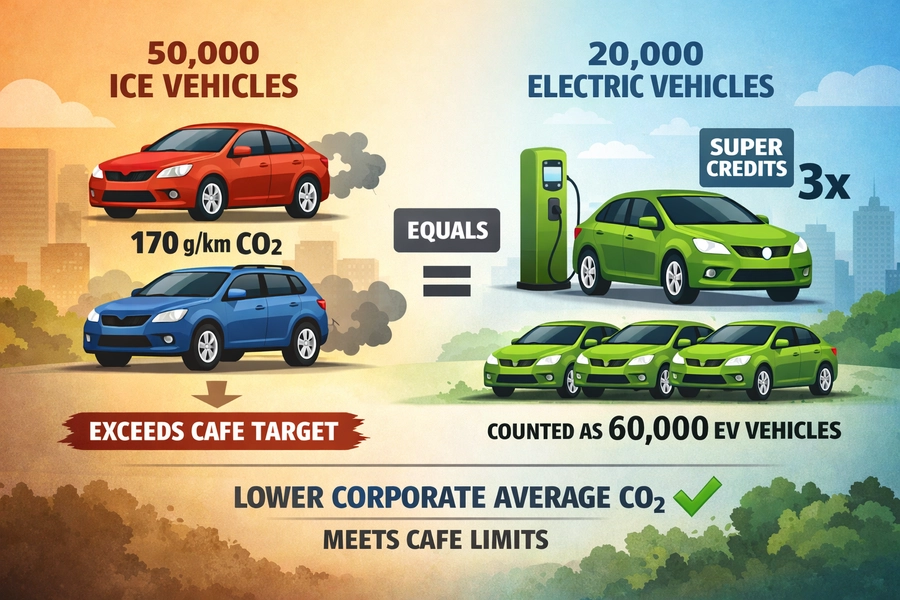
The effective fleet size increases, while the total CO2 emissions remain unchanged, significantly lowering the corporate average and potentially bringing it within the prescribed limit. Under the super-credit mechanism, a single battery electric vehicle is counted as three ICE vehicles, while a strong hybrid vehicle is counted as two ICE vehicles for the purpose of fleet-average calculations This demonstrates how manufacturers use a mix of internal combustion, hybrid, and electric vehicles to achieve compliance rather than relying on individual models alone.
Future Outlook: Proposed CAFE 2027 Framework
Looking ahead, the proposed CAFE 2027 framework seeks to tighten these standards further. Draft norms indicate a phased reduction in permissible average fuel consumption over five years, with values expected to fall to approximately 3.01 litres per 100 kilometres by 2032. The draft also expands incentives for electric vehicles, strong hybrids, and alternative fuels through enhanced super credits and carbon neutrality factors, reinforcing the policy push toward electrification and lower-carbon mobility.
Ultimately, CAFE norms represent a shift from regulating individual vehicles to enforcing corporate-level responsibility for fuel efficiency and emissions. As targets become progressively stricter, these norms are reshaping vehicle design, accelerating adoption of hybrid and electric technologies, and influencing the overall structure of the Indian passenger vehicle market. Over the long term, CAFE norms are expected to deliver lower fuel consumption, reduced CO2 emissions, and a more sustainable automotive ecosystem aligned with India’s energy and environmental goals.