
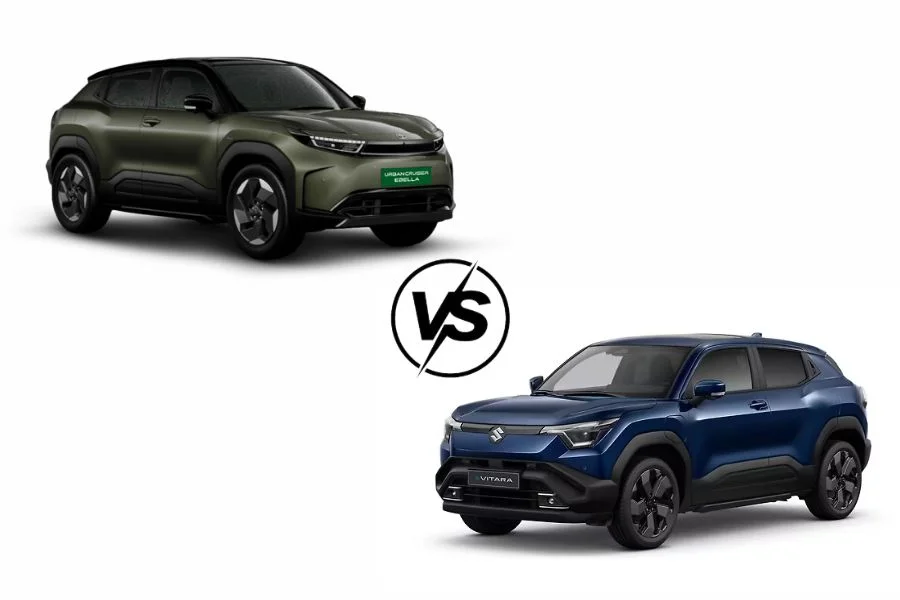
The strategic partnership between Maruti Suzuki and Toyota Kirloskar Motor, formalised in 2018, has played a pivotal role in reshaping the Indian automotive landscape. What began as a mutually beneficial alliance to share platforms, powertrains, and technologies first materialised in the form of the Toyota Glanza, a rebadged version of the Maruti Suzuki Baleno.
Since then, the collaboration has expanded across multiple segments, culminating in jointly developed models that cater to evolving market demands. The Maruti Suzuki e Vitara and the Toyota Urban Cruiser Ebella represent the partnership’s foray into the mass-market electric SUV space, offering two distinct interpretations of the same underlying product. Today we cover the Ebella and e Vitara differences in detail, focusing on design, features, and market approach.
Urban Cruiser Ebella and e Vitara differences – Exterior Design
While both electric SUVs share identical body panels and proportions, the most noticeable Ebella and e Vitara differences emerge at the front. The Maruti Suzuki e Vitara adopts a more aggressive stance with standalone LED headlamps with Y-shaped LED DRLs, a pair of functional fog lamps, and a sharply sculpted front bumper that lends it a sportier character.
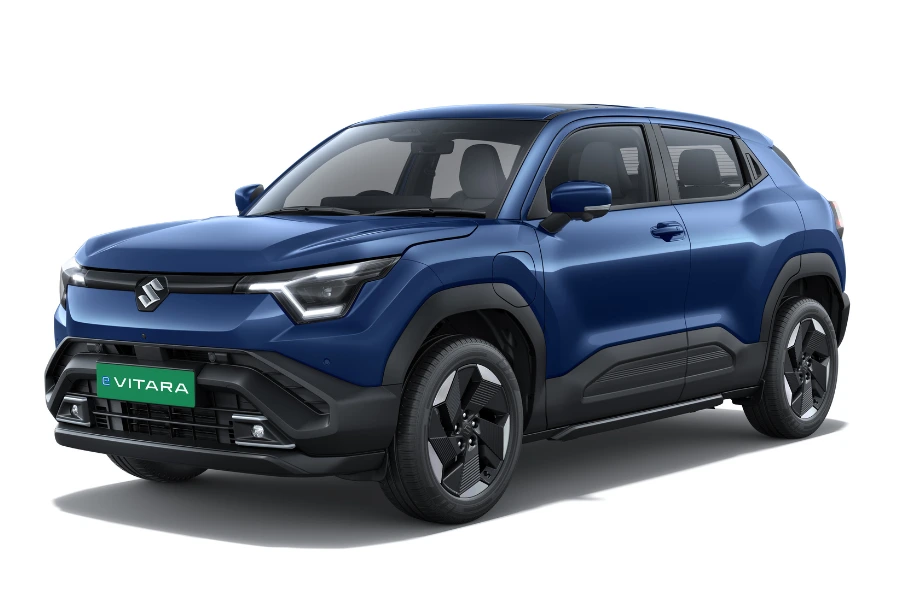
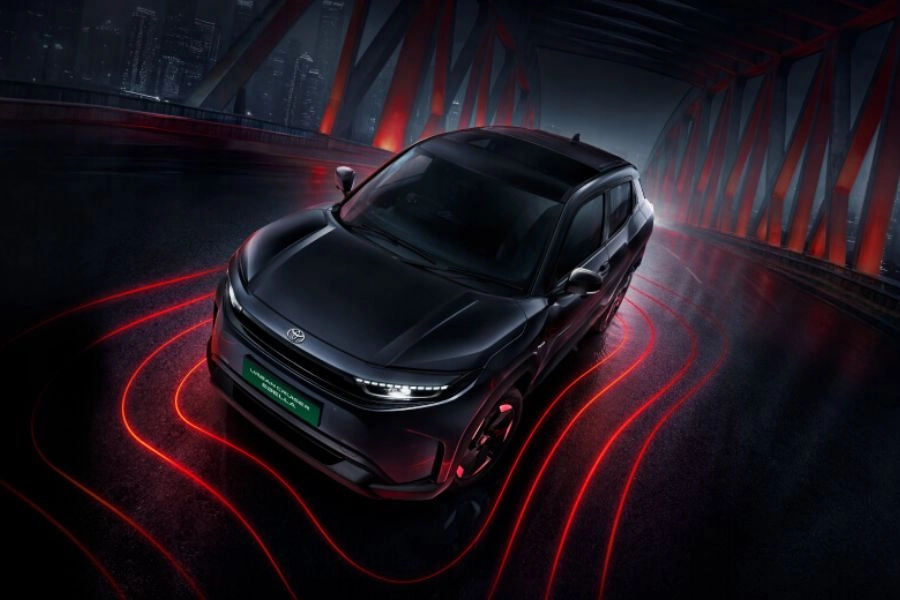
In contrast, the Toyota Urban Cruiser Ebella features a cleaner, more futuristic front fascia. It comes with an LED headlamp setup connected by a closed off piano-balck grille and a smooth, minimalist bumper design inspired by Toyota’s global “hammerhead” design philosophy. Notably, the Ebella omits fog lamps altogether. To accommodate these distinct front-end treatments, both models also feature slightly different bonnet designs.
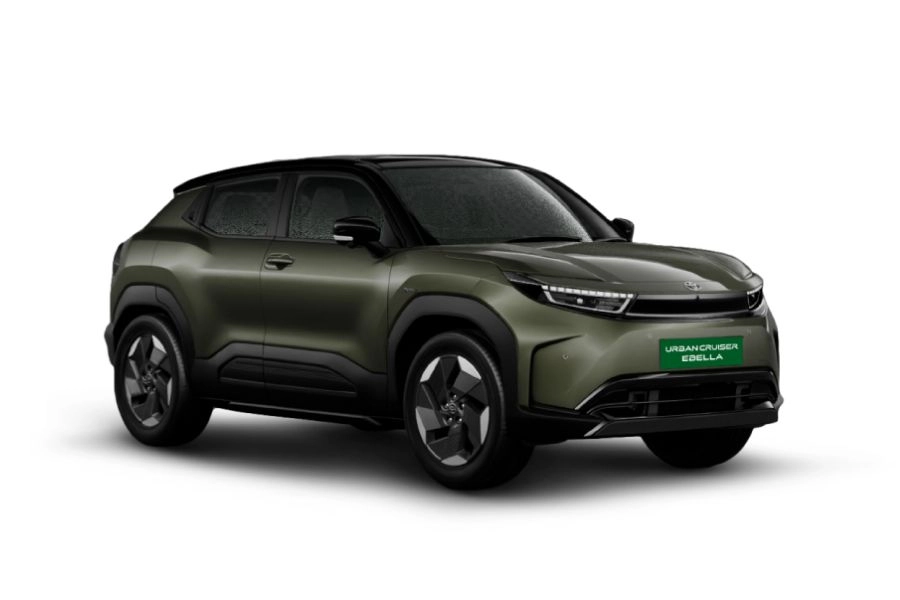
At the rear, the two SUVs are largely identical in shape and structure, with differentiation limited to LED tail-lamp signatures and badging. The e Vitara places the Suzuki logo centrally with the e Vitara badge below it, whereas the Ebella carries a centrally mounted Toyota logo, with “Urban Cruiser” badging on the lower left and “Ebella” on the lower right.
Urban Cruiser Ebella and e Vitara differences – Interior Design and Features
Both the Maruti Suzuki e Vitara and Toyota Urban Cruiser Ebella feature an identical cabin layout with no functional Ebella and e Vitara differences, highlighted by a floating 10.25-inch touchscreen infotainment system paired with a 10.1-inch fully digital instrument cluster that integrates vehicle data and other telemetry.
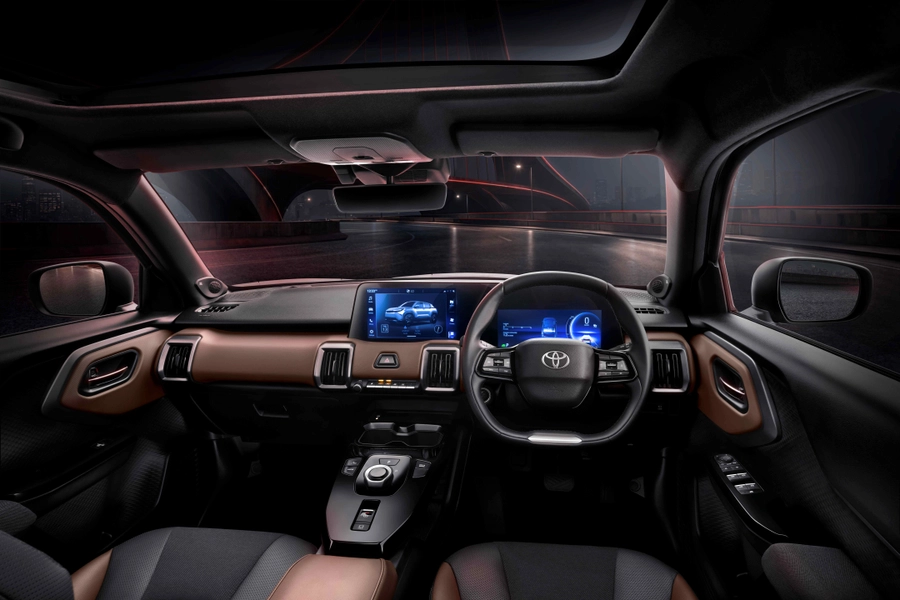
The interior features include wireless Apple CarPlay and Android Auto, a wireless phone charger, a two-spoke flat-bottom steering wheel, brushed silver-finished rectangular AC vents, and physical climate control buttons, along with part-fabric, part-leatherette upholstery. Comfort is enhanced through automatic climate control, ventilated front seats, a 10-way power-adjustable driver’s seat, and reclining 40:20:40 split rear seats, reinforcing the shared premium experience across both models.
Urban Cruiser Ebella and e Vitara differences – Battery Pack and Range
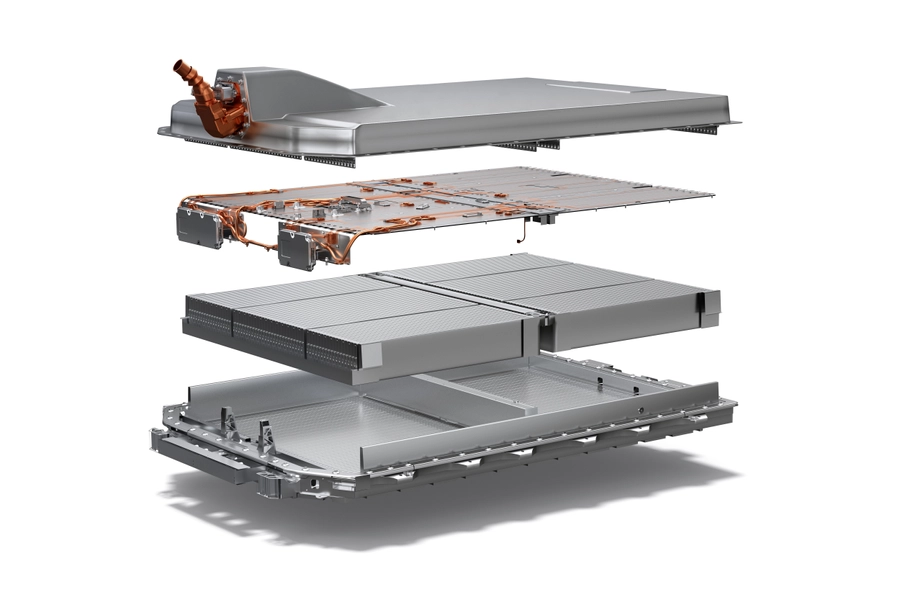
Both the Maruti Suzuki e Vitara and Toyota Urban Cruiser Ebella share identical electric powertrain specifications, reinforcing the absence of any mechanical Ebella and e Vitara differences. Both models are offered with two lithium-iron phosphate (LFP) battery options—a 49 kWh pack producing 142 hp and a larger 61 kWh unit delivering 172 hp, with torque output rated at 189 Nm in both configurations.
The larger 61 kWh battery is claimed to offer a driving range of up to 543 km on a single charge, while charging support includes AC and DC fast charging with CCS2 compatibility. Additional efficiency-enhancing features such as battery pre-heating and a heat pump system are also common to both SUVs, aiding performance and range consistency across varying climatic conditions.
Urban Cruiser Ebella and e Vitara differences – Safety
Urban Cruiser Ebella and e Vitara differences – Market Positioning and Rivals
One of the most significant ebella and e Vitara differences lies in market positioning rather than hardware. Toyota is expected to offer its Battery as a Service (BaaS) model with the Urban Cruiser Ebella, allowing customers to reduce the upfront cost of the vehicle by subscribing to the battery separately. Maruti Suzuki, on the other hand, has not commented on whether the e Vitara will be offered with BaaS and currently retails it through the conventional ownership model.
In the broader electric SUV market, both models will target the same set of rivals such as the Mahindra BE 6, Hyundai Creta EV, MG ZS EV, Tata Curvv.ev and VinFast VF6, competing on factors including price, driving range, feature set, brand trust, and after-sales support. As of now, neither Maruti Suzuki nor Toyota has announced pricing for their respective electric SUVs. Maruti Suzuki has also not opened official bookings for the e Vitara, while Toyota has confirmed that bookings for the Urban Cruiser Ebella are scheduled to open from January 20, 2026.