
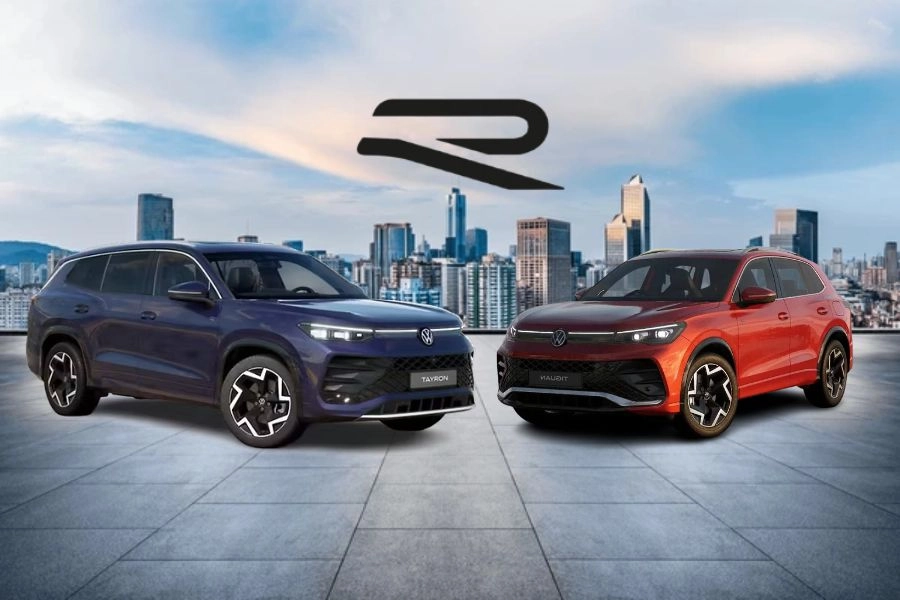
Volkswagen’s premium SUV strategy in India has expanded with the presence of two closely related models that cater to different buyer needs. The Tiguan and Tayron differences are becoming an important talking point as both SUVs share a common platform and design philosophy but differ significantly in execution and positioning. The Tiguan R-Line has already been introduced as a five seat performance focused SUV imported from Europe, while the Tayron R-Line is expected to arrive as a larger, more practical seven seat offering assembled in India.
Despite their similarities, the two models diverge in key areas such as size, features, driving configuration, and overall market role. This article takes a closer look at the Tiguan and Tayron differences across exterior design, interior features, powertrain setup, safety equipment, and pricing strategy.
Volkswagen Tiguan and Tayron Differences – Exterior Design
The Tiguan and Tayron differences are clearly reflected in their exterior proportions and overall size. The Tiguan R-Line is offered solely as a five seat SUV, which is evident in its more compact dimensions and balanced stance. It measures 4,539 mm in length, 1,859 mm in width, and 1,656 mm in height, with a wheelbase of 2,680 mm.

The Tayron R-Line is larger across all key dimensions, primarily to accommodate a three row seating layout. It measures 4,792 mm in length, making it 253 mm longer than the Tiguan, while its width stands at 1,866 mm, which is 7 mm wider. The Tayron is also marginally taller at 1,665 mm, compared to the Tiguan’s 1,656 mm, and has a longer wheelbase of 2,789 mm, an increase of 89 mm.
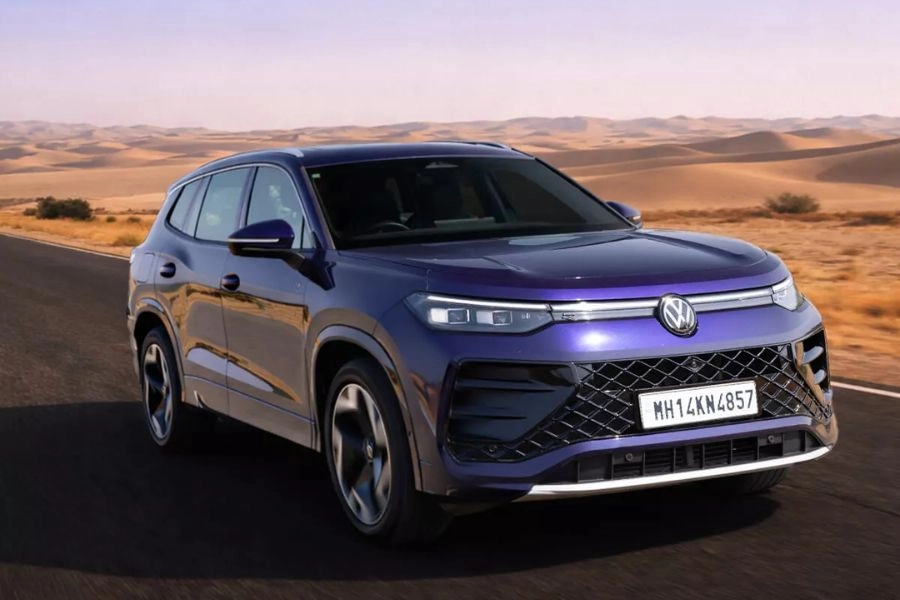
Despite the difference in size, both SUVs share the same R-Line exterior elements. These include LED matrix headlamps connected by an illuminated strip, R-Line specific bumpers, a sculpted bonnet, and 19 inch alloy wheels. These shared design elements ensure visual consistency across Volkswagen’s R-Line SUV lineup, while the dimensional differences define the Tiguan and Tayron differences in exterior design and positioning.
Volkswagen Tiguan and Tayron Differences – Interior Design and Features
The Tiguan and Tayron differences become more pronounced once inside the cabin. Both the VWs offer premium interiors with a large 15-inch touchscreen infotainment system, 10.25-inch digital instrument cluster, panoramic sunroof, ambient lighting and heated steering wheels. The Tiguan’s front seats are equipped heating and massage functions. However, the Tiguan does not feature powered seat adjustment, a powered tailgate, or a 360 degree camera. The Tiguan has to also make do with just a 8 speaker VW branded audio system.
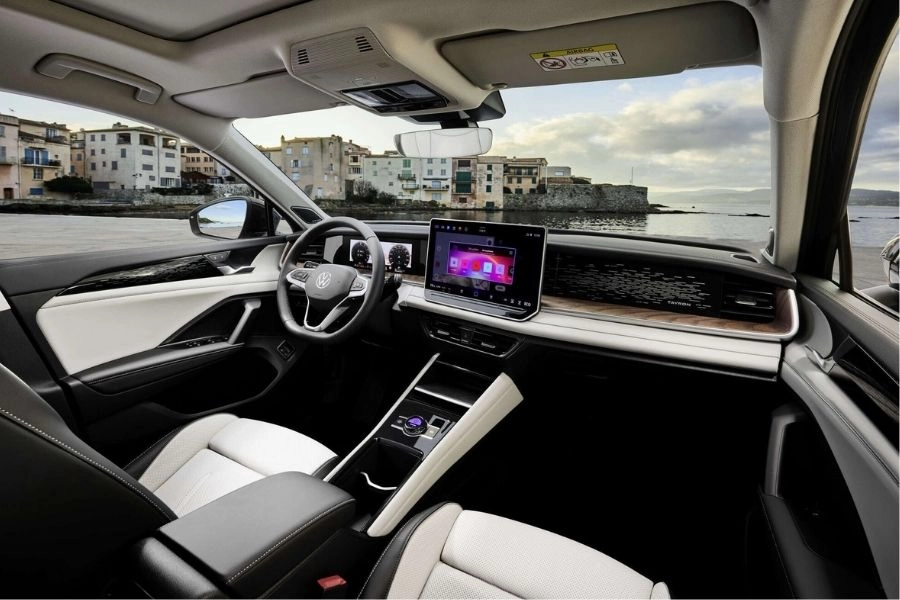
The Tayron R-Line addresses these gaps with a more feature rich cabin setup. It comes equipped with electrically adjustable front seats with memory, heating, ventilation, and massage functions. The Tayron also offers a powered tailgate with gesture control, and a 360 degree camera system, both of which are absent on the Tiguan. The Tayron also features a 700w 11 speaker Harmon Kadron audio system with a subwoofer and amplifier. In addition, the Tayron’s seven seat configuration and sliding second row provides greater flexibility. These interior upgrades form a major part of the Tiguan and Tayron differences.
Volkswagen Tiguan and Tayron Differences – Powertrain
Mechanically, both SUVs are closely related, but there are still notable Tiguan and Tayron differences in few aspects. Both models are powered by a 2.0 litre turbo petrol engine paired with a seven speed DSG automatic gearbox and an all wheel drive system. Power and torque outputs remain the same for both cars at 204 hp and 320 Nm of torque.

The Tiguan R-Line offers four selectable drive modes and comes equipped with Dynamic Chassis Control, allowing the suspension to adapt to different driving conditions. This feature enhances ride comfort and handling depending on the selected mode. The Tayron R-Line offers six drive modes, ideally providing greater adaptability across varied terrain and driving scenarios. However, the availability of Dynamic Chassis Control on the Tayron has not yet been confirmed for India and will only be clear after launch.
Volkswagen Tiguan and Tayron Differences – Safety Features
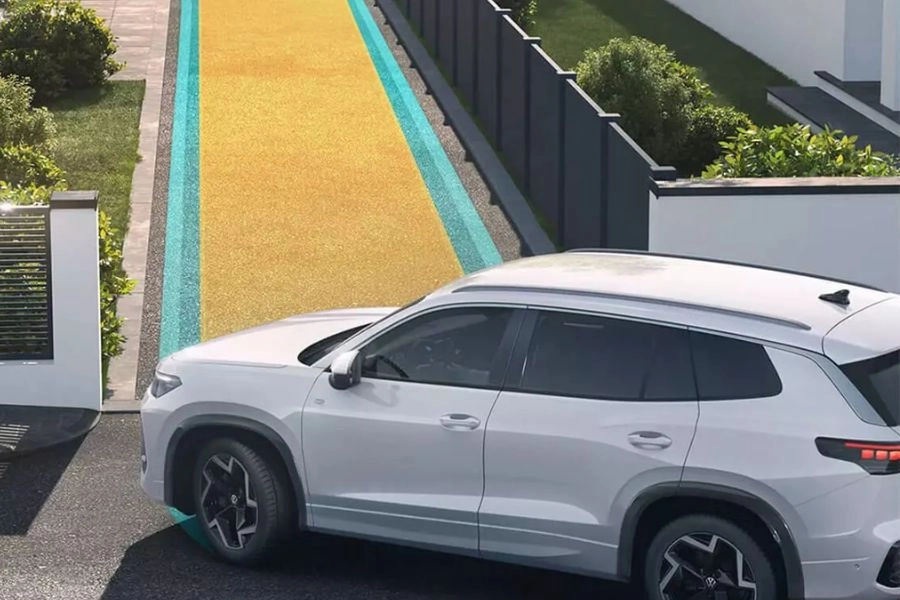
In terms of safety, the Tiguan and Tayron differences are minimal. Both SUVs offer nine airbags and a comprehensive Level 2 advanced driver assistance system package. Features such as adaptive cruise control, lane assist, autonomous emergency braking, and driver monitoring are standard on both models. The Tayron additionally benefits from its 360 degree camera system, which enhances parking assistance.
Volkswagen Tiguan and Tayron Differences – Market Positioning
One of the most important Tiguan and Tayron differences lies in pricing and market placement. The Tiguan R-Line, imported into India as a completely built unit, is positioned as a premium five seat SUV and is currently priced at ₹45.73 lakh ex showroom. Its pricing reflects its CBU status and places it in a very niche segment.
The Tayron R-Line, in contrast, will be assembled in India as a completely knocked down unit. Volkswagen has not yet revealed its pricing, and final figures will only be announced closer to launch. Once introduced, the Tayron R-Line is expected to operate in the premium seven seat SUV space and will compete with models such as the Skoda Kodiaq, Jeep Meridian, Toyota Fortuner and MG Gloster. These positioning differences underline the Tiguan and Tayron differences, with each SUV addressing a distinct segment despite sharing a common platform and design.
Pingback: Volkswagen Tayron R-Line launched at Rs 46.99 lakh: All about Fortuner’s new rival - Shutterdrives