
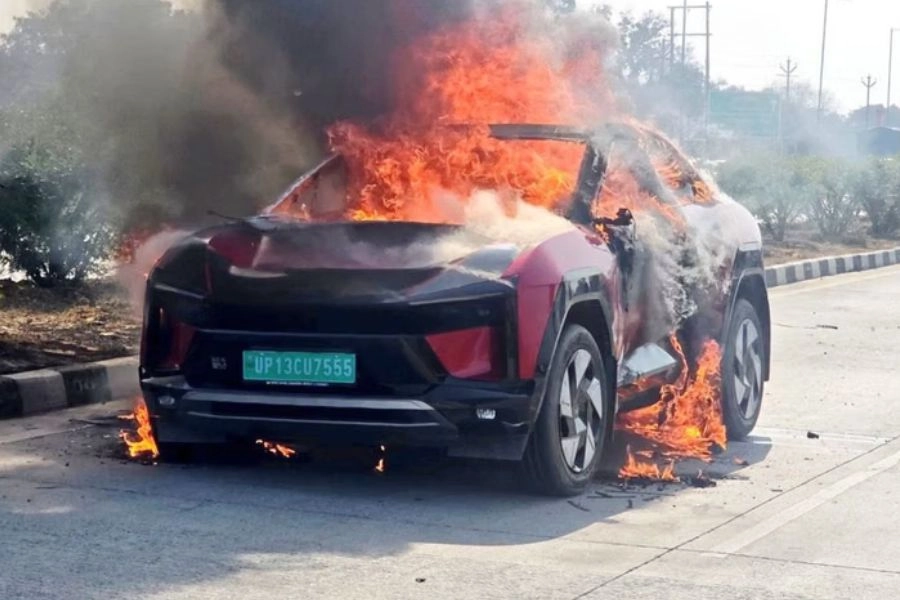
An unfortunate incident involving a Mahindra BE 6 electric SUV was reported recently in Uttar Pradesh, where the vehicle caught fire and was completely destroyed. The incident occurred near Gulaothi, with visuals of the burning SUV quickly surfacing online and triggering concerns around electric vehicle safety. The vehicle involved was identified as a Mahindra BE 6 Pack Two variant, equipped with the 59kWh battery pack.
Fortunately, all occupants inside the vehicle managed to exit safely and were unharmed. While the vehicle itself was a total loss, the absence of injuries ensured the incident did not escalate into a more serious tragedy.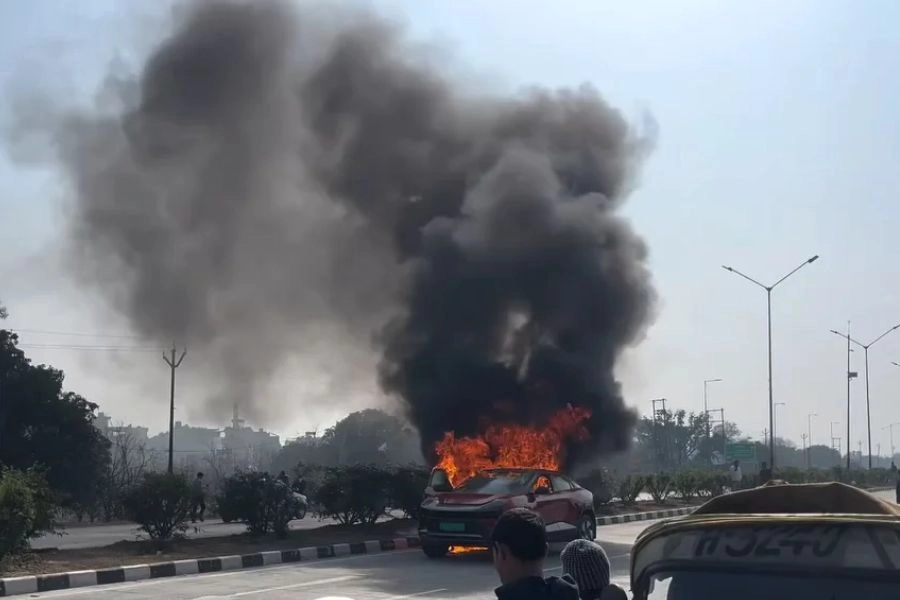
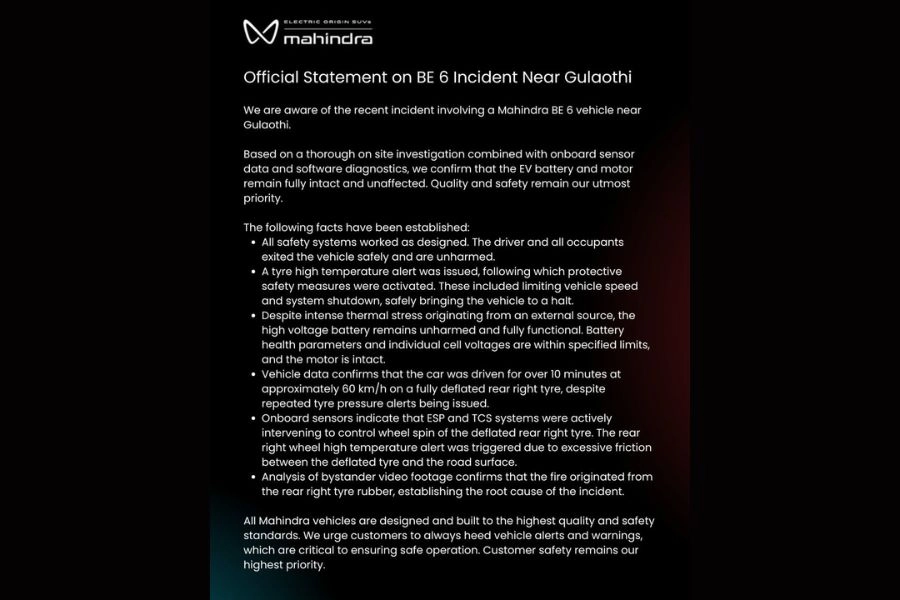
Following the incident, Mahindra & Mahindra initiated a detailed investigation and released an official statement outlining the findings based on on-site inspection, onboard vehicle data, and diagnostic analysis. Here’s a breakdown of what Mahindra says led to the incident.
What Mahindra’s Investigation Revealed
According to Mahindra, a thorough investigation combining physical inspection, sensor data, and software diagnostics confirmed that the high-voltage battery pack and electric motor remained structurally intact and unaffected throughout the incident. Importantly, the fire did not originate from the battery or the electric drivetrain a critical distinction in EV-related incidents.
As per Mahindra’s data logs, it shows that the vehicle was driven for over 10 minutes at approximately 60km/h with a fully deflated rear right tyre, despite multiple tyre pressure monitoring system (TPMS) alerts being issued to the driver. During this period, electronic safety systems such as Electronic Stability Program (ESP) and Traction Control System (TCS) were actively intervening to manage wheel spin caused by the deflated tyre.
As the vehicle continued to be driven, excessive friction between the deflated tyre and the road surface led to a sharp rise in temperature at the rear right wheel. This triggered a high-temperature alert, following which the vehicle’s safety protocols were activated. These included limiting vehicle speed and eventually initiating a system shutdown, bringing the car to a controlled halt.
Further analysis of bystander video footage reportedly confirmed that the fire originated from the rear right tyre rubber, establishing it as the root cause of the blaze. Despite exposure to intense external heat, Mahindra stated that battery health parameters, including individual cell voltages, remained within prescribed safety limits, and the battery pack remained fully functional.
Mahindra BE 6 – Battery Options, Range and Features
The Mahindra BE 6 is part of the brand’s new-generation electric SUV lineup and is underpinned by Mahindra’s INGLO electric architecture. The Pack Two variant involved in the incident is powered by a 59kWh lithium-ion battery pack. The Mahindra BE 6 was launched in 2024 and is currently priced at ₹18.9 lakhs (ex-showroom) to ₹27.65 lakhs (ex-showroom).

This battery is paired with a rear-mounted electric motor producing approximately 231hp and 380Nm of torque, making the Mahindra BE 6 one of the more performance-focused electric SUVs in its segment. Mahindra claims a MIDC-certified range of over 500km for the 59kWh variant . The Mahindra BE 6 is also a higher 79 kWh variant available with 282 hp and 380 Nm.
The BE 6 supports fast charging, allowing the battery to be charged from 20 to 80 percent in under 30 minutes using a DC fast charger. Feature highlights include a dual-screen cabin layout, advanced driver assistance systems (ADAS), multiple drive modes, connected car technology, and a comprehensive suite of active and passive safety features. Most recently Mahindra launched the BE 6 Formula e Edition.

Mahindra BE 6 – A Reminder on Vehicle Alerts and Driver Responsibility
Mahindra, in its official communication, reiterated that all its vehicles are designed and built to stringent quality and safety standards. The company also urged customers to pay close attention to vehicle alerts and warnings, particularly critical ones such as tyre pressure and temperature alerts, which are designed to prevent precisely such incidents.
While EV fires often raise concerns around battery safety, this incident highlights that external factors such as driving on a fully deflated tyre can lead to severe consequences regardless of the powertrain. The investigation suggests that the vehicle’s safety systems functioned as intended, preventing injuries and containing damage to the vehicle alone.
As electric vehicles become more common on Indian roads, incidents like these underline the importance of timely driver intervention and adherence to safety warnings, alongside robust vehicle engineering.