
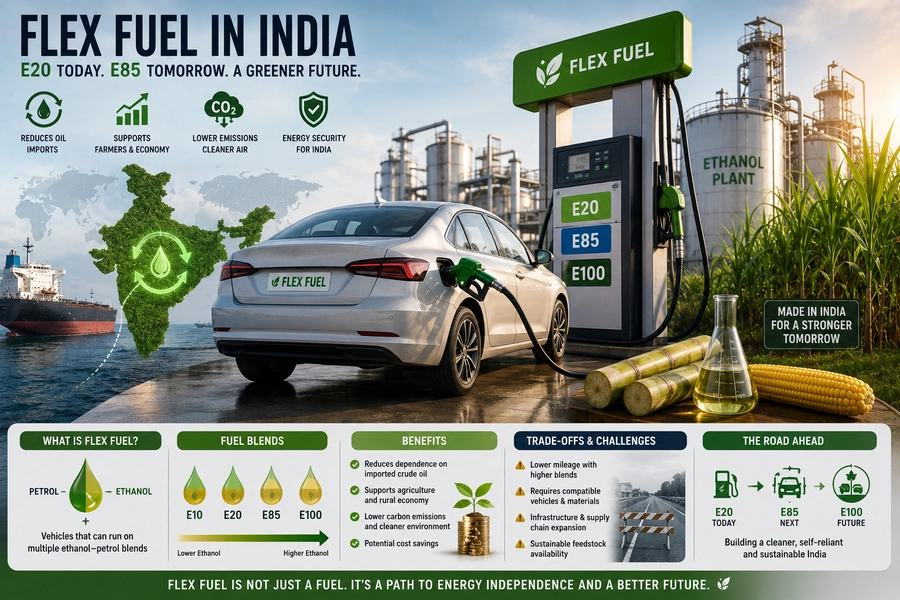
Flex fuel vehicles are emerging as a key part of India’s transition strategy toward cleaner mobility while still relying on internal combustion engines. As the country pushes for reduced oil imports and lower emissions, ethanol blending has taken centre stage, with E20 already rolled out nationwide and higher blends like E85 and E100 under consideration. In this context, flex fuel technology offers a practical bridge by allowing vehicles to run on varying ethanol petrol mixtures without requiring major user intervention.
Flex fuel vehicles are internal combustion engine vehicles that can run on more than one type of fuel, typically petrol and ethanol blends in varying proportions. The engine management system detects the ethanol content and adjusts parameters such as fuel injection and ignition timing accordingly. This allows the same vehicle to seamlessly operate on petrol, E20, E85 or higher blends, depending on what is available.
Flex Fuel – The Basics
Flex fuel refers to a mixture of petrol and ethanol, where ethanol is a biofuel produced from plant based sources such as sugarcane, corn, molasses and agricultural residue. Ethanol is an alcohol based fuel that burns cleaner than petrol and can be produced domestically, making it strategically important for countries like India.
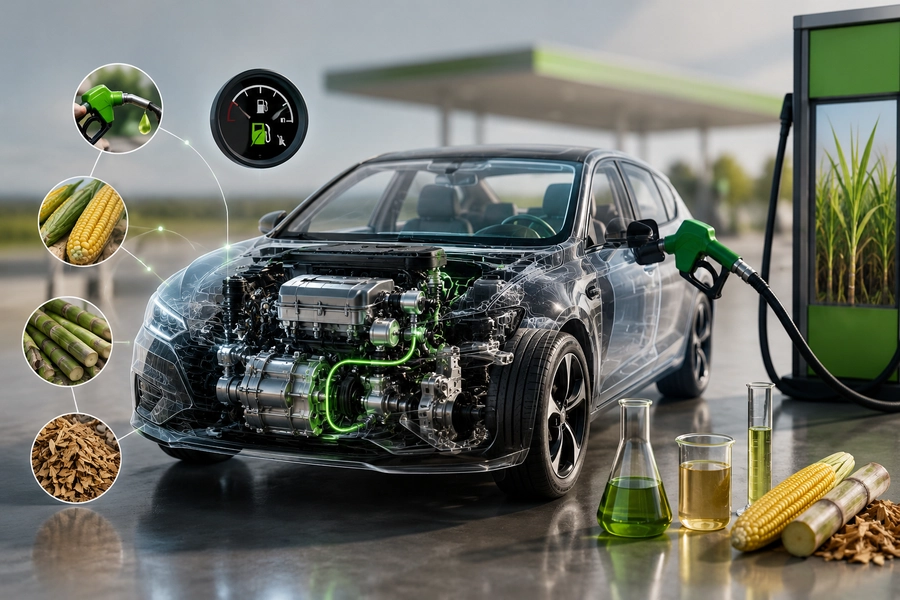
The composition of flex fuels is defined by ethanol percentage. E10 contains 10 percent ethanol, while E20 contains 20 percent ethanol and is now the standard petrol blend in India. Higher blends include E85, which contains 85 percent ethanol, and E100, which is nearly pure ethanol used in specially designed engines. These higher blends require flex fuel compatible engines due to differences in combustion properties and material compatibility.
Flex Fuel – Environmental and Economic Benefits
The benefits of flex fuel and ethanol blending are significant. One of the biggest advantages is reduced dependence on crude oil imports. India relies heavily on imported oil, and replacing a portion of petrol with domestically produced ethanol helps reduce this dependence and improves energy security. It also reduces exposure to global crude price fluctuations.
Ethanol blending also supports the agricultural economy. Sugarcane farmers and related industries benefit from increased demand for ethanol feedstock, creating a more stable income stream. This aligns with rural development goals and diversifies revenue sources for farmers.
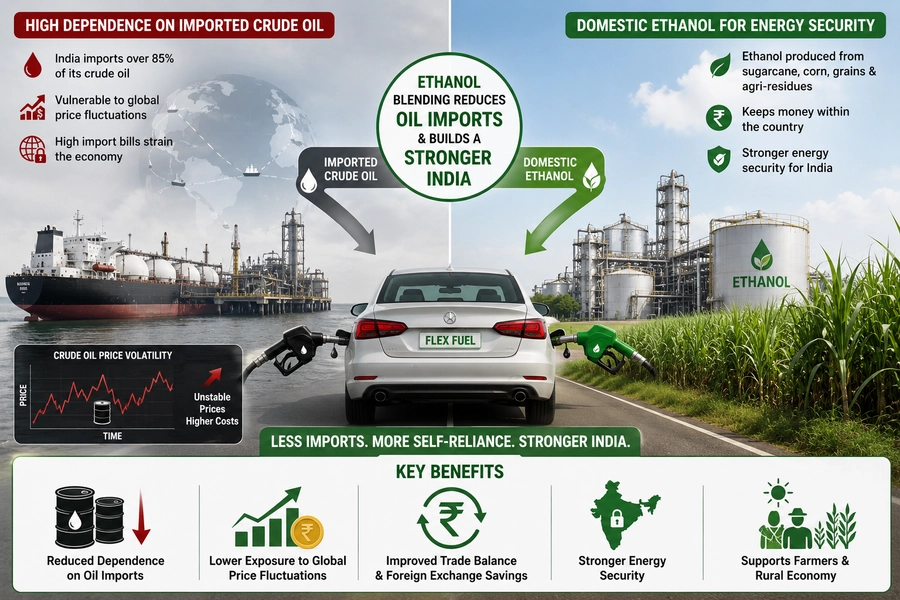
From an environmental standpoint, ethanol burns cleaner than petrol and produces lower carbon monoxide and greenhouse gas emissions. Over its lifecycle, ethanol derived from biomass can result in lower net carbon emissions compared to fossil fuels. This makes it a useful tool in reducing the transport sector’s carbon footprint without immediately shifting to full electrification.
There are also potential cost advantages. Ethanol can be cheaper to produce domestically than importing petrol, and in some global markets higher ethanol blends like E85 are priced lower. If such pricing benefits are passed on, it could reduce running costs for consumers over time.
Flex Fuel – Trade offs and Disadvantages
However, there are trade offs and disadvantages that need to be considered. The most notable is lower fuel efficiency. Ethanol has lower energy density than petrol, which means more fuel is required to produce the same amount of energy. As a result, vehicles running on E20 may see a small drop in mileage, and this reduction becomes more pronounced with higher blends like E85.

Compatibility is another concern, especially with older vehicles. While newer engines are being designed for E20 and beyond, older vehicles may face issues related to material degradation in fuel lines, seals and engine components when exposed to higher ethanol content. Although regulators state that E20 is safe for most vehicles, long term effects remain a point of discussion.
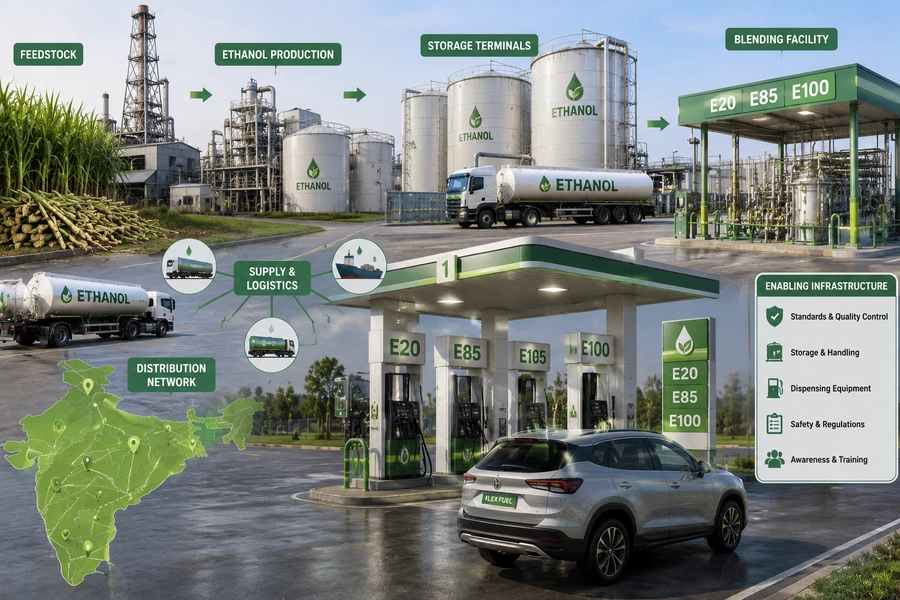
Infrastructure and supply chain challenges also exist. While E20 is now widely available, higher blends like E85 and E100 will require significant expansion in fuel distribution infrastructure. Ethanol production itself must scale up without negatively impacting food supply or water resources, as crops like sugarcane are water intensive.
Flex Fuel – The Transition
In India, the transition is already underway. E20 fuel has been rolled out nationwide, marking a major milestone in the ethanol blending programme. The government is now working on policies to enable the use of higher ethanol blends such as E85 and E100, along with encouraging automakers to develop flex fuel compatible vehicles.

The implications of this shift are wide ranging. It strengthens energy independence and supports rural economies, but also requires advancements in vehicle technology and fuel infrastructure. Automakers will need to ensure that engines can handle higher ethanol content efficiently without compromising durability or performance.
In conclusion, flex fuel vehicles represent a transitional solution that allows India to move toward cleaner fuels while leveraging existing engine technologies. With E20 already in place and higher blends on the horizon, ethanol based fuels are set to play a crucial role in the country’s energy and mobility strategy. The long term success of this approach will depend on balancing economic benefits, environmental gains and practical implementation challenges.
Pingback: Hero MotoCorp Splendor Plus and HF Deluxe Flex Fuel Launched: Up to E85 Compliant ! - Shutterdrives